I Can Spot Your AI Writing in One Sentence.
Here's What Gives It Away.
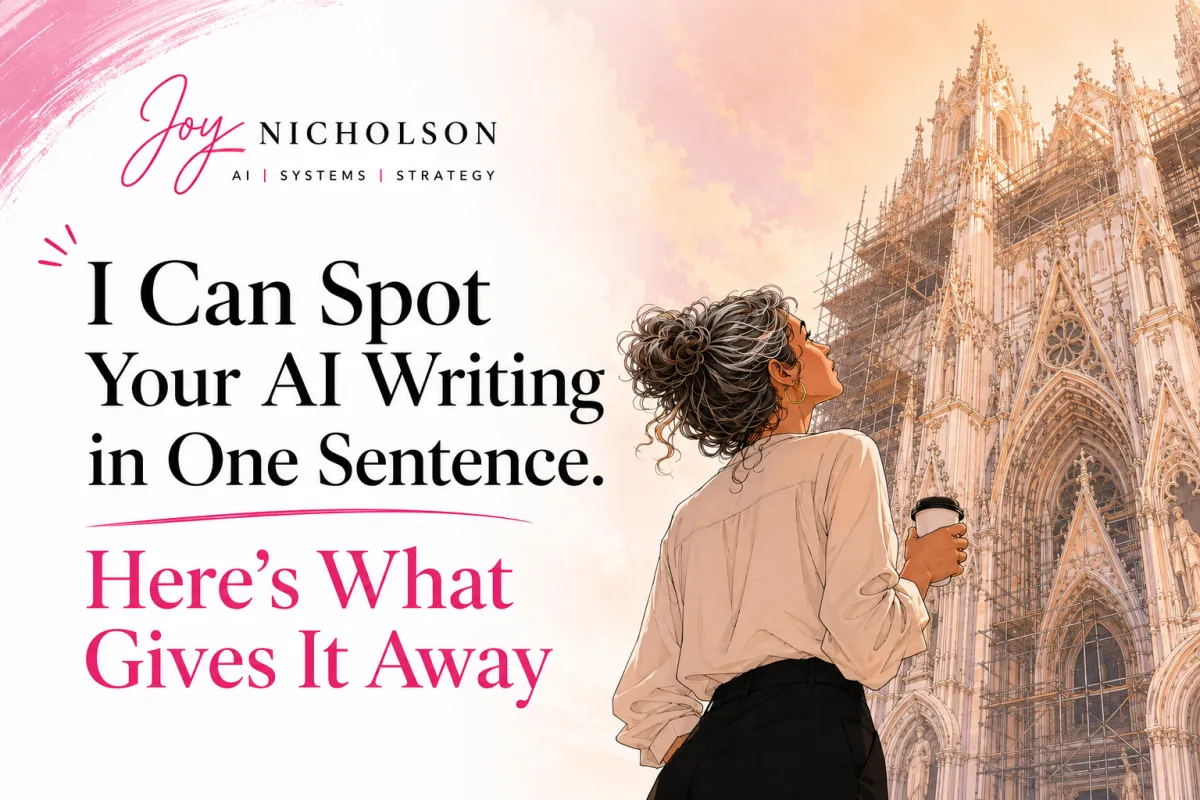
I stood under the Sagrada Familia in Barcelona in 2024, looking straight up through a forest of cranes. Scaffolding wrapped around half the towers. Construction nets hung off spires that had been rising since before my grandparents were born.
Gaudí started that build in 1883. He died in 1926, still working on it, never seeing it finished. Generations of stonemasons and architects carried it on after him, carving columns that branch like trees inside what people call a stone forest, fitting stained glass that floods the whole interior with colour by mid afternoon. Eighteen spires in total, each one its own kind of patience.
It took a hundred and forty four years. Let that sink in. The main structure was finally declared architecturally complete in February 2026, when the Tower of Jesus Christ, the tallest spire of the lot, was finished. Fourteen point four decades for one building, because nobody could rush that level of detail and craft. Someone had to teach the next mason the curve, the cut, the vision, generation after generation, until it was actually done.
Half my coaching calls start the same way. Someone typed one prompt, got something flat back, and decided the tool was broken. Or that it sounds like average AI Slop.
It was never broken. And yes it will sound like AI Slop. It was untaught.
AI is the same deal as that cathedral. It is not a finished masterpiece that appears the second you ask for one. It is something you build, skill by skill, teaching it your voice and your standards the way that build site taught new masons the shape of a column. Mastery takes time. It always has, with every tool worth having. The difference is your timeline is months, not a century and a half.
And nowhere does that show up faster than in your writing.

The fingerprint AI leaves behind
Once you know what to look for, you cannot unsee it.
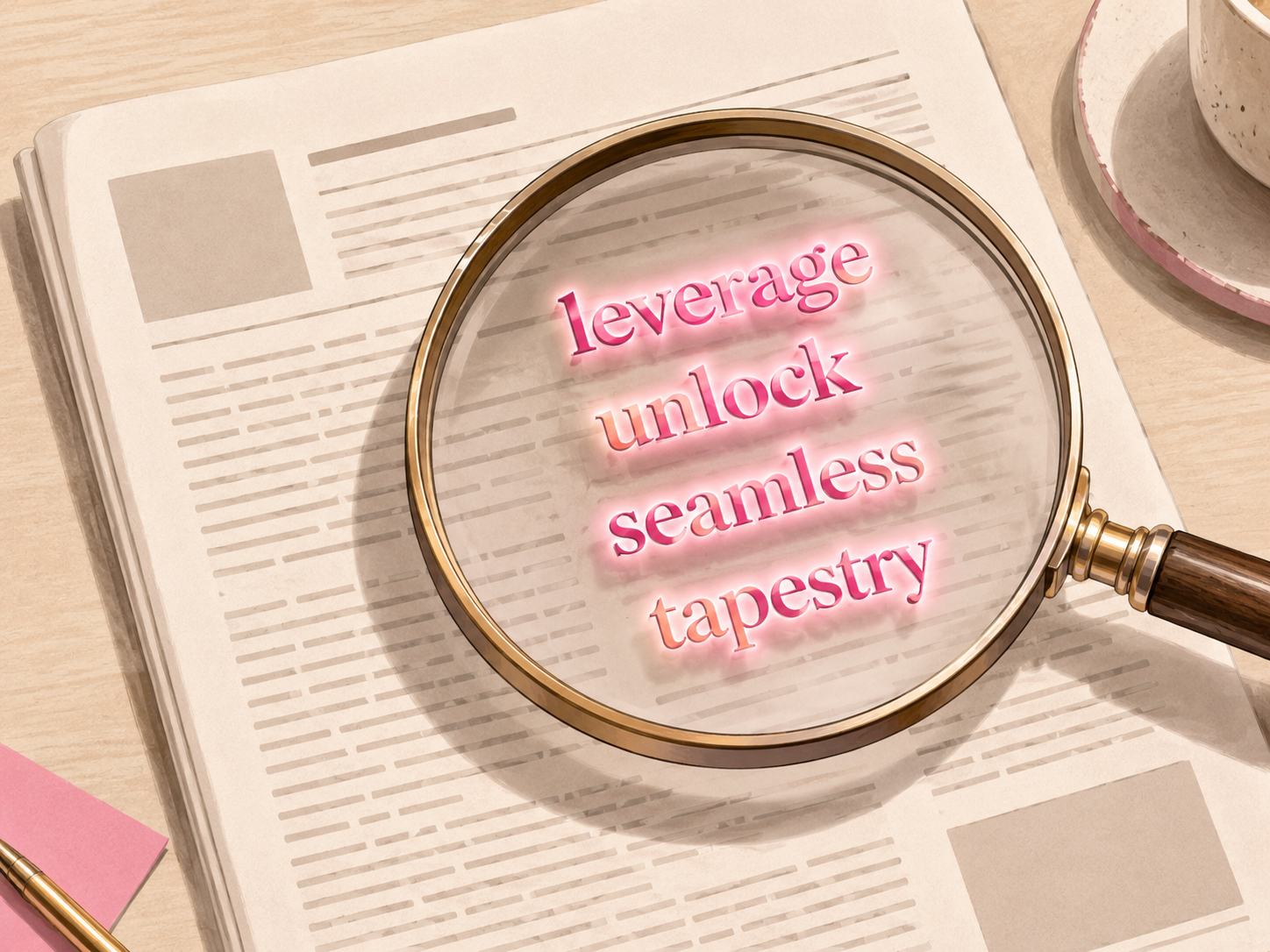
It starts with the words. Delve, leverage, unlock, harness, elevate, seamless, robust, tapestry, landscape. None of these are wrong sitting alone in a dictionary. The tell is hearing them from a business owner who would never actually say "we leverage cutting edge solutions" to a client's face, yet there it is in their newsletter.
Then there's the sentence shape. "It's not just a haircut, it's a transformation." "It's not just coffee, it's a ritual." It used to feel clever. Now researchers can actually track how overused it's become, with one analysis finding this exact construction more than quadrupled in business writing between 2023 and 2025. Your reader's brain clocks the pattern before they've even finished reading the line.
AI also loves grouping things in threes. Speed, efficiency, and innovation. Passion, purpose, and clarity. It makes shallow thinking sound thorough. And it reaches for fake enthusiasm on command: "I'm so absolutely thrilled to share this game changing opportunity with you." Nobody talks like that over coffee, so why would they write it.
But the real giveaway, more than any single word or trick, is what's missing. No specific detail. No real story. No opinion the writer would actually defend if you pushed back on it. Just smooth, agreeable, forgettable words sitting where a personality should be.
Why this is costing you more than you realise
Here's where it stops being a style complaint and starts being a business one.
The moment someone suspects content was written by AI, more than half disengage immediately. Trust in AI generated content has been dropping for two years running, even among people you'd expect to be more relaxed about it. One study found shoppers were four times more likely to trust a brand less, not more, the second the marketing felt machine made.
What's interesting is most people aren't actually anti-AI. Over 80 percent of consumers say they're completely fine with a brand using AI to help write, as long as the final piece still feels human. That's the whole game, right there in one sentence. People don't mind the tool. They mind feeling like nobody was behind it.
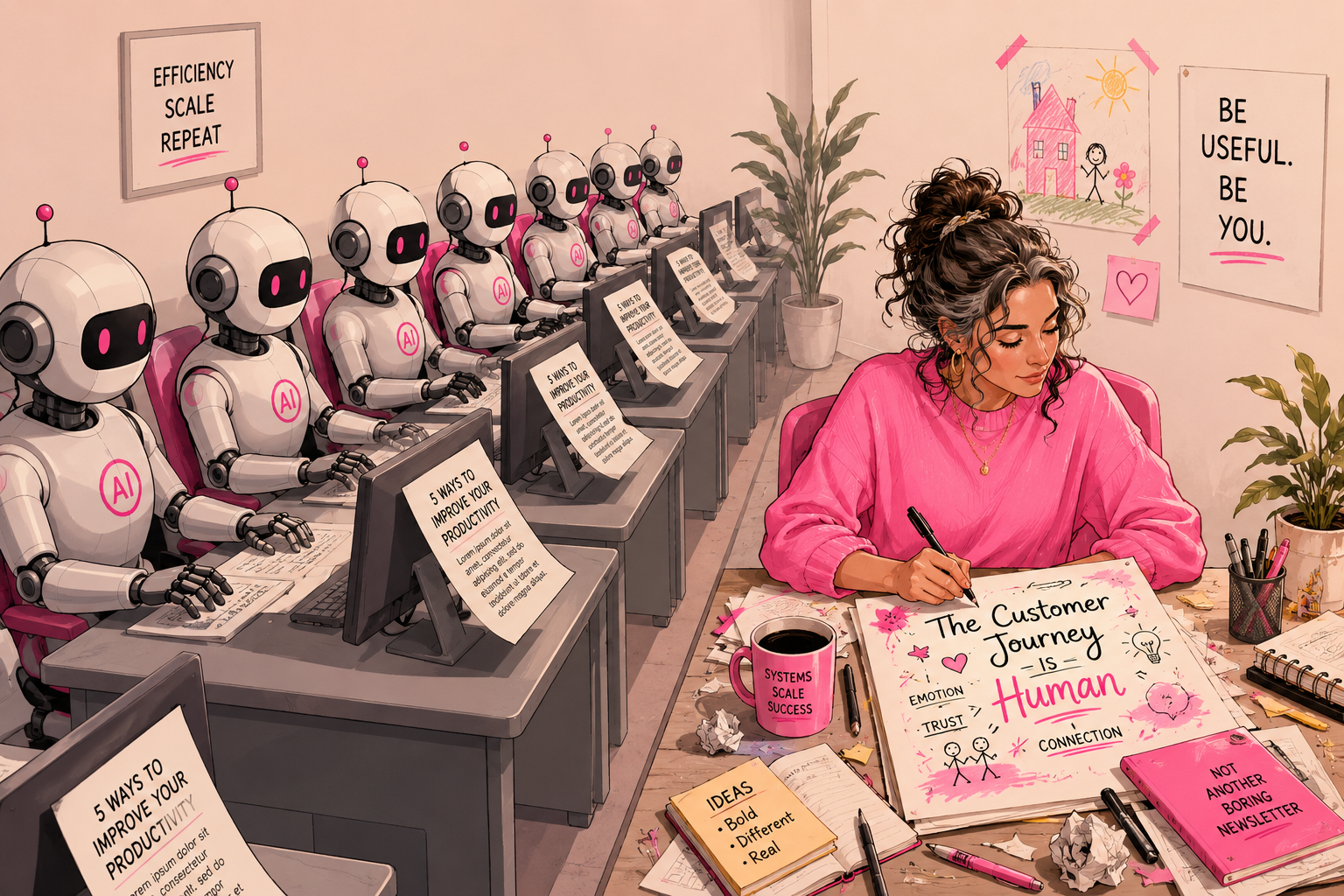
And here's the strategic problem underneath all of it. Every business in your space has access to the same AI you do. If you're all prompting the same way and publishing whatever comes out first, you're all starting to sound like each other. Generic used to just be unconvincing. Now it's invisible. Voice has become the one thing left that actually sets you apart, because it's the one thing AI cannot manufacture on its own. It can only amplify whatever you feed it.
How to actually use AI without losing yourself in it
This is the part most people skip, and it's the part that changes everything.
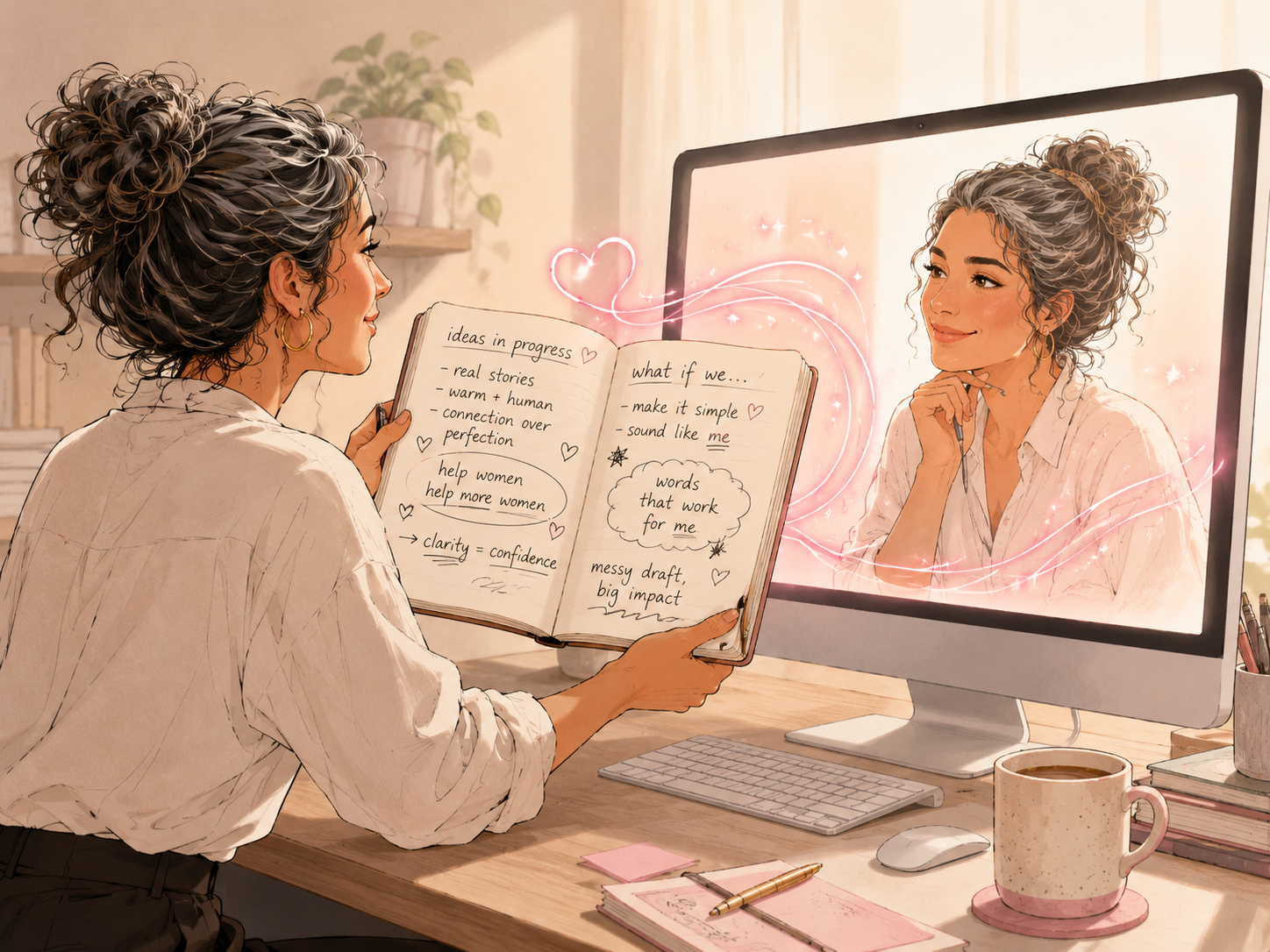
Feed it your own words first. Before you ask AI to write anything new, paste in three or four pieces you've already written in your real voice. An email, a caption, a voice note you transcribed, anything that sounds like you on a normal Tuesday. Ask it to study the rhythm and word choices, not just the topic. AI without a voice sample is guessing. AI with one is actually working for you.
Build a banned word list and keep it in every prompt. If you wouldn't say "seamlessly transform your business overnight" to a client's face, don't let it sit in your newsletter either. Tell the tool exactly what to avoid, not just what to include.
Write the first line yourself. Always. AI rarely opens well. It throat clears, it reaches for "in today's world," it stalls before it starts. You write the hook, the scene, the real moment, then let AI help you build out from there. The opening is where your voice has to show up loudest, so don't hand that part over.
Treat every draft as a rough cut. Never a finished piece. Read it out loud before you post it. If a line makes you cringe a little, that's usually the AI talking, not you.
Put one true, specific thing in everything you publish. A real number from your business. An actual client conversation, even a brief one. A genuine opinion you'd stand behind if someone disagreed with you. Specificity is the one thing AI cannot invent on your behalf, because it doesn't have your life. You do.
Read it back and ask one question. Does this sound like me, or does it sound like a brand. If it sounds like a brand, you've still got work to do.
None of this means using AI less. It means using it like a sharp tool in your hand, instead of letting it drive.
The bit nobody wants to hear
I'll be real with you. Most business owners don't have an AI problem. They have a voice problem wrapped up in a bad system that AI is now making louder and faster.
If your content sounded a bit beige before ChatGPT ever existed, AI hasn't fixed that. It's just helped you produce more beige content, more quickly, at a much bigger scale. Volume was never the issue. Voice was.
The good news is voice is fixable. It's actually one of the simpler things to dial in once you know what you're aiming for. Like that cathedral, it just takes someone willing to teach it properly instead of expecting it finished overnight.
This is exactly what we work through in my one to one AI coaching session. Ninety minutes, just us, digging into your actual voice and building you a system and a set of prompts that sound like you on your best day. You walk out with something you can reach for every time you sit down to write, so you're never left wondering if a post sounds robotic after you've already hit publish.
If you've read this far wondering whether your last five posts sound more like you or more like a chatbot trying to be helpful, that's usually a sign worth listening to.
What would change in your content if every piece actually sounded like you?
Download Your FREE 'Your-Clients-Can-Tell' PDF (no email addy required)
Want to fix your brand-voice - Book your 1:1 session today. Spaces are limited.