You Don’t Have an AI Problem.
You Have a Thinking Problem.
There is a particular kind of business guilt that arrives quietly, usually while you are checking your bank account.
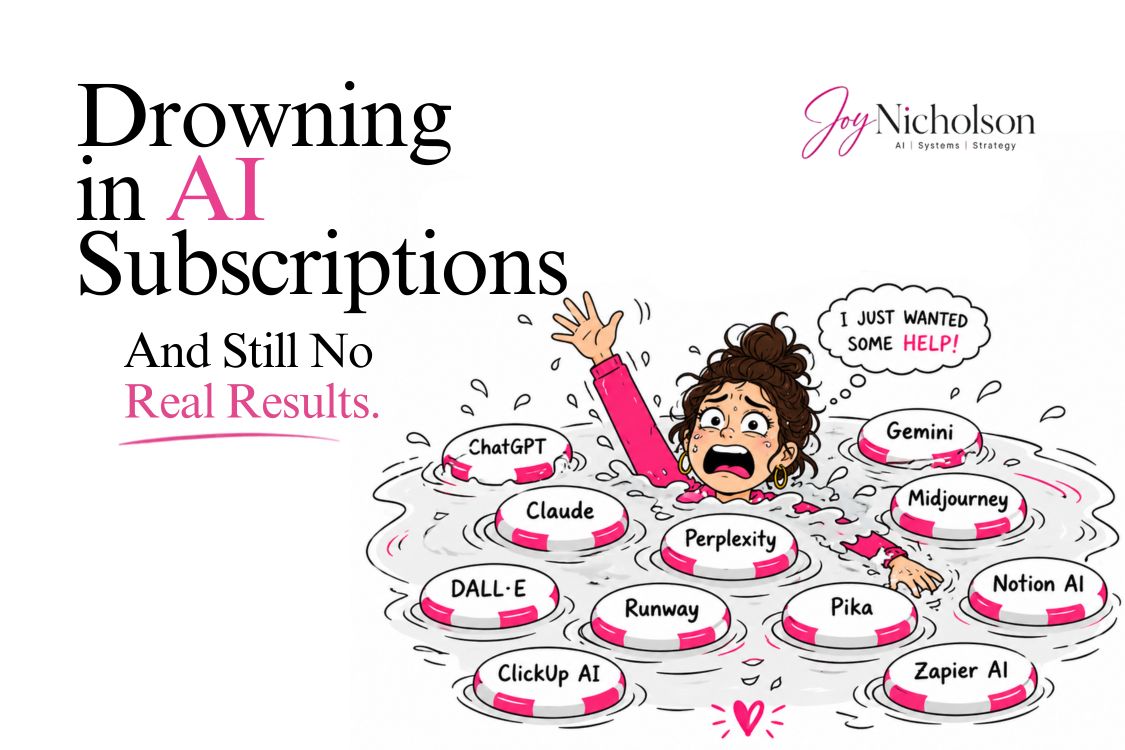
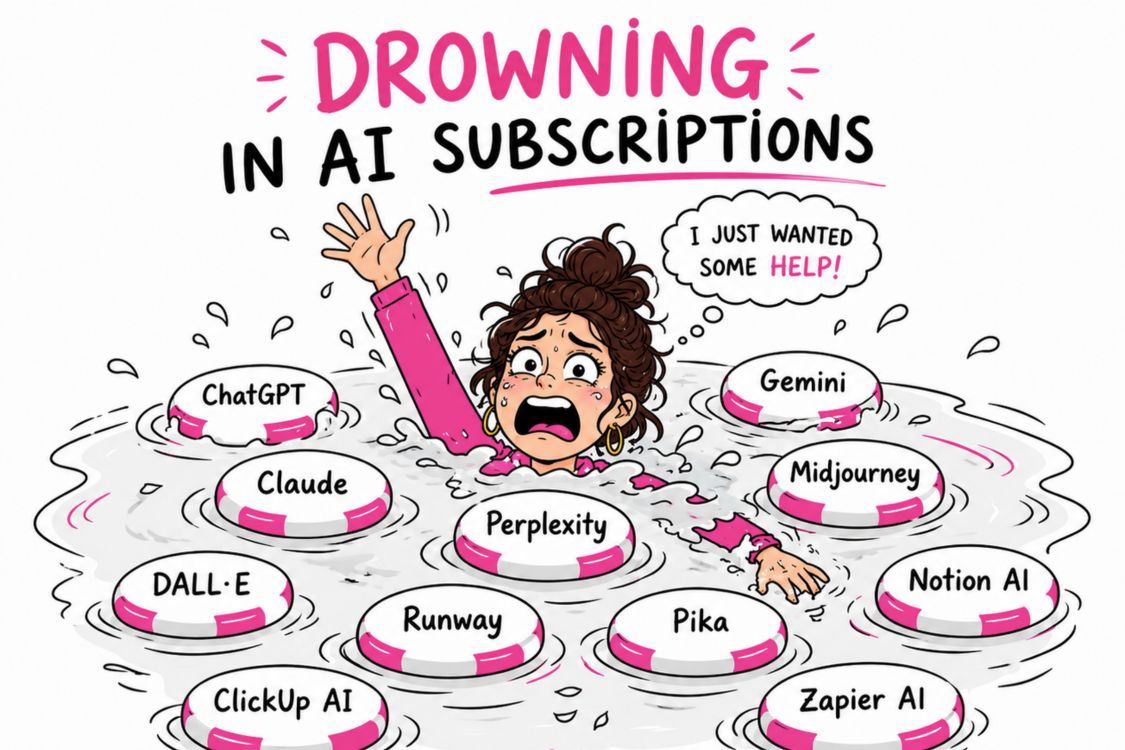
You see another subscription payment come out for a tool you barely remember signing up for. It may only be $29, $47 or $79, which does not seem disastrous on its own. The problem is that it is rarely alone. It sits beside the content tool, the automation tool, the CRM upgrade, the meeting assistant, the design platform and at least one AI app someone swore would completely transform your business.
For a moment, you consider cancelling it. Then you remember why you bought it in the first place. You were overwhelmed, behind on content, inconsistent with follow-ups and tired of carrying your entire business around in your head. The tool promised to make things easier, and at the time, easier sounded like a very good investment.
Three months later, the tool is still charging you. Your business is still messy.Your systems are still broken. And you still don't have a workable marketing ecosystem.
This is the part of the AI conversation that nobody seems particularly interested in discussing. We have spent the last few years telling small business owners that AI will save them time, make them more productive and help them compete with larger companies. What we have not said loudly enough is that AI cannot organise a business the owner has not thought through.
It cannot clarify an offer that was never clear. It cannot understand a customer the business owner only vaguely understands. It cannot create a consistent brand voice when the person behind the business has never taken the time to define what they actually believe.
AI does not fix unclear thinking. It exposes it.
The tool is rarely the real problem
Imagine someone decides to build a bookshelf.
They go to the hardware store and buy an expensive drill, a circular saw, a laser level, an electric sander and a large box of screws. They watch a few tutorials, lay everything out across the garage floor and feel ready to begin.
There is only one problem. They have not measured the wall.
They do not know how high the bookshelf needs to be, how much weight it must hold, what type of timber they need or whether the finished piece will fit through the doorway. They have purchased every tool required to build the bookshelf, but they have not made a plan for the bookshelf itself.
By the end of the weekend, the garage is filled with timber offcuts, half-drilled holes and increasing frustration. The bookshelf does not exist, so they begin to question the drill.

This is how many small business owners are using AI.
They are purchasing tools before drawing the plans. They are trying new platforms before identifying the bottleneck. They are collecting prompts, templates and automations before deciding what the business is actually trying to achieve.
When the result is disappointing, they assume they need a better tool.
They usually do not.
We have confused access with adoption
Almost anyone can open an AI platform and ask it to write something. That does not mean AI has been meaningfully adopted into the business.
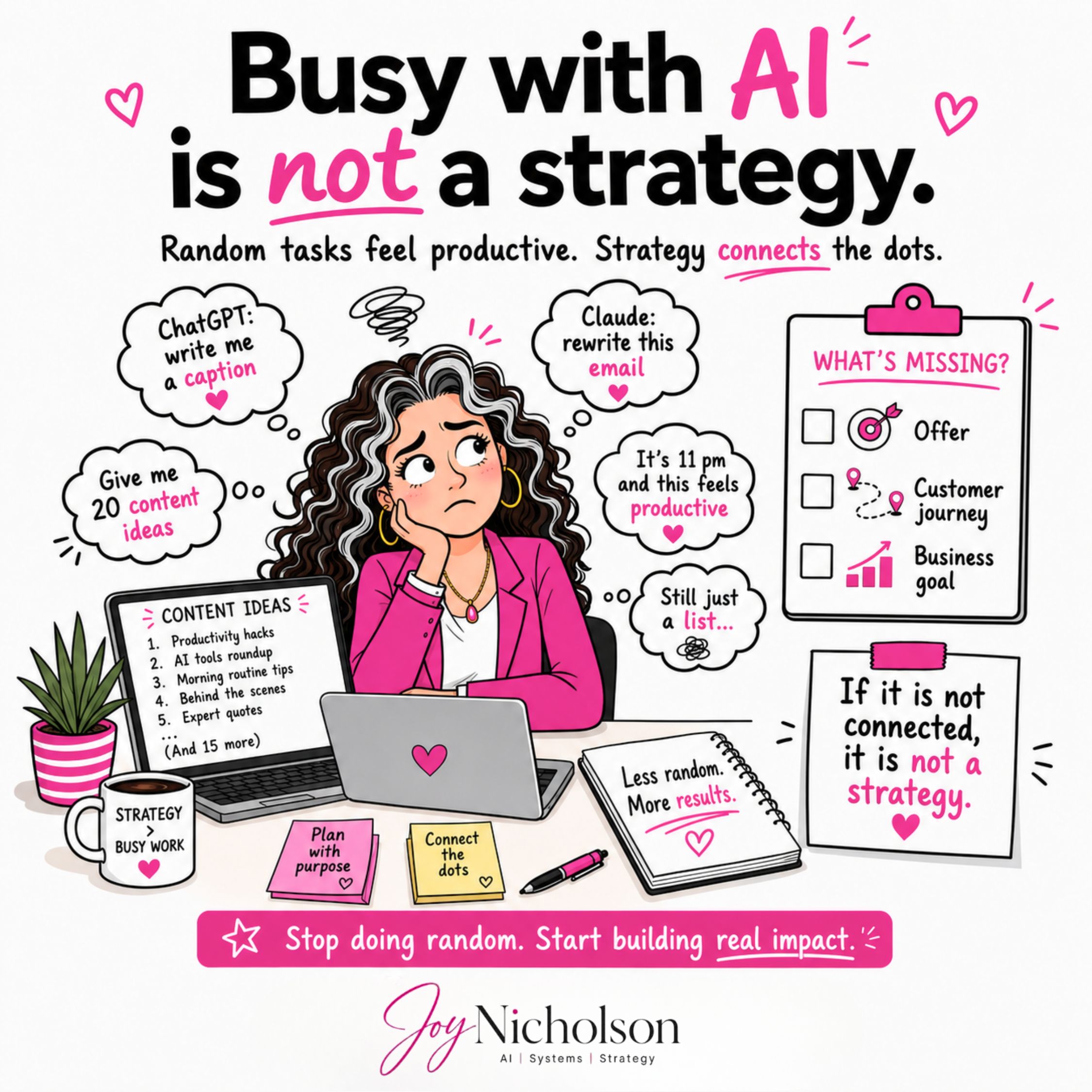
Using ChatGPT to produce a caption once a fortnight is not an AI strategy. Asking Claude to rewrite an email is not digital transformation. Generating a list of content ideas at 11 pm may feel productive, but unless those ideas are connected to an offer, a customer journey and a clear business goal, it is still just a list.
This distinction matters because the AI industry has become very good at celebrating activity. The number of users is rising. More businesses are experimenting. More tools are being released. More tasks can be automated.
But activity is not the same as progress.
A business owner can spend an entire afternoon inside an AI platform and still make no meaningful decision. They can generate thirty captions, twelve lead magnet ideas and five versions of a sales page without becoming any clearer about who they serve or why someone should buy from them.
The uncomfortable truth is that AI can make procrastination look extremely sophisticated.
Instead of avoiding the hard questions by reorganising a desk or checking email, business owners can now avoid them by building custom assistants, downloading prompt packs and testing new software. It feels strategic because the technology is advanced.
Often, it is simply another way to stay busy without confronting what is not working.
AI gives you more of what is already there
The biggest myth surrounding artificial intelligence is that it will somehow provide the missing strategy. The magic key to making your millions or fix what is broken in your business.
It will not.
AI is a multiplier. When it is given clear thinking, strong positioning and useful information, it can produce very impressive results. When it is given confusion, vague instructions and contradictory ideas, it produces polished confusion. When you business is broken it will give you broken results.
That may sound harsh, but it is also freeing. It means the problem is not that you are bad at AI. The problem may be that you are asking technology to make decisions you have been avoiding.
A vague prompt usually begins with a vague business.
“Write a social media post for my coaching business” sounds like a reasonable request, but it contains almost nothing useful. What type of coaching business? Who is the audience? What do they already believe? What are they frustrated by? What does the business owner believe that competitors are too cautious to say? What action should the reader take?
Without those answers, AI fills in the blanks with the safest possible language. It produces phrases such as “unlock your potential,” “take your business to the next level” and “embrace this game-changing opportunity.”
The output sounds generic because the input was generic.
Business owners then spend forty-five minutes trying to remove the generic language. They tell the tool to sound more human, more natural, more conversational and less robotic. What they are really asking is, “Can you somehow sound like me, even though I have not shown you who I am?”
No tool can solve that properly.
The subscription stack has become a hiding place
There is a reason buying another platform feels so appealing. Purchasing a tool is easier than making a decision.
It is easier to subscribe to a content platform than to decide what you want to be known for. It is easier to buy a CRM than to build a follow-up process. It is easier to install an automation than to admit that the customer journey makes no sense.
The tool creates the feeling of movement without requiring the discomfort of clarity.

This is not a criticism of small business owners. Most are already carrying too much. They are delivering the service, finding clients, managing cash flow, answering messages, solving problems and trying to maintain some version of a life outside the business.
When a platform promises to take work off their plate, of course they listen.
The problem is that tools do not remove complexity when the complexity has not been understood. They often add another layer to it. Now the owner has the original problem, plus another dashboard, another login, another tutorial and another monthly payment.
The business was disorganised before the tool arrived. Now the disorganisation has software.
The real work starts before the prompt
Before AI can become useful, several questions need to be answered clearly.
Who is the business actually for? Not “women aged 35 to 55” or “small business owners who want to grow.” Those descriptions are too broad to shape meaningful content, messaging or offers.
A useful understanding of the customer goes deeper. What happened in their life or business that made the problem urgent? What have they already tried? What are they tired of hearing? What are they embarrassed to admit? What outcome do they want badly enough to spend money solving?
The next question is equally important. What does the business actually do?
Many business owners can list their services but struggle to explain the result. They describe sessions, packages, templates and support, but not the change someone experiences after buying.
AI cannot create a strong message from a weak offer. It can rearrange the wording, but it cannot manufacture relevance.
Then there is voice. Most people think brand voice is about sounding friendly, professional or conversational. That is only the surface.
A real brand voice is built from beliefs, experiences, standards and opinions. It includes the things you are willing to say when others in your industry remain vague. It reflects the stories you tell, the language you naturally use and the ideas you repeatedly return to.
AI can imitate a voice once that voice has been demonstrated. It cannot invent an authentic one on your behalf.
Speed is useless without direction
The appeal of AI is speed. It can complete tasks in seconds that once took hours.
But speed is only valuable when the direction is correct.
A GPS is useful because you enter a destination. Without one, it is simply a map showing hundreds of possible roads. AI works the same way. If the business has a clear destination, AI can help identify a faster route. If the destination is unclear, AI simply provides more options.
More ideas are not always helpful. More content is not always valuable. More automation is not always progress.
Many small business owners do not need another fifty content ideas. They need to decide which three ideas support the offer they are trying to sell.

They do not need an automated follow-up system capable of sending fifteen different emails. They need one clear follow-up process that feels human and gets used consistently.
They do not need an AI assistant for every department. They need to identify the small number of tasks that are repetitive, time-consuming and suitable for AI support.
AI makes it possible to move very quickly. That is precisely why unclear thinking becomes more dangerous.
You can now create the wrong content faster, target the wrong audience more consistently and automate a broken process at scale. Efficiency is not automatically a virtue. A business can become highly efficient at doing things that should not be done at all.
Some business owners are using AI to avoid becoming better at business
This may be the most polarising part of the conversation, but it needs to be said.
Some business owners are not using AI to strengthen their thinking. They are using it to avoid thinking.
They want AI to tell them what their offer should be, who their audience is, what they believe, how they should sound and what they should post. They are not looking for assistance. They are looking for replacement.
That approach may produce content, but it will not build authority.
Authority comes from having a point of view. It comes from experience, judgment and the willingness to make decisions. It comes from seeing something in your industry that others have missed, then explaining it in a way that helps people think differently.
AI can help articulate that perspective. It cannot live the experience that created it.
The risk is not only that AI-generated content sounds generic. The deeper risk is that business owners slowly stop developing their own ideas. They begin outsourcing the very thinking that makes the business worth listening to.
A company with no clear opinion becomes easy to ignore. A founder who sounds like everyone else becomes replaceable.
In a marketplace flooded with AI-generated content, human judgment becomes more valuable, not less.
The businesses winning with AI are not necessarily using more of it
The strongest AI users are often not the people with the largest technology stack. They are the people with the clearest systems.
They know what the business is trying to achieve. They understand the customer. They have a defined offer, a recognisable voice and a repeatable way of working.
Because that foundation exists, they can use AI selectively.
They may use it to analyse customer feedback, organise research, repurpose long-form content, improve follow-up, identify patterns or turn rough thinking into a structured first draft. The tool supports the process instead of becoming the process.
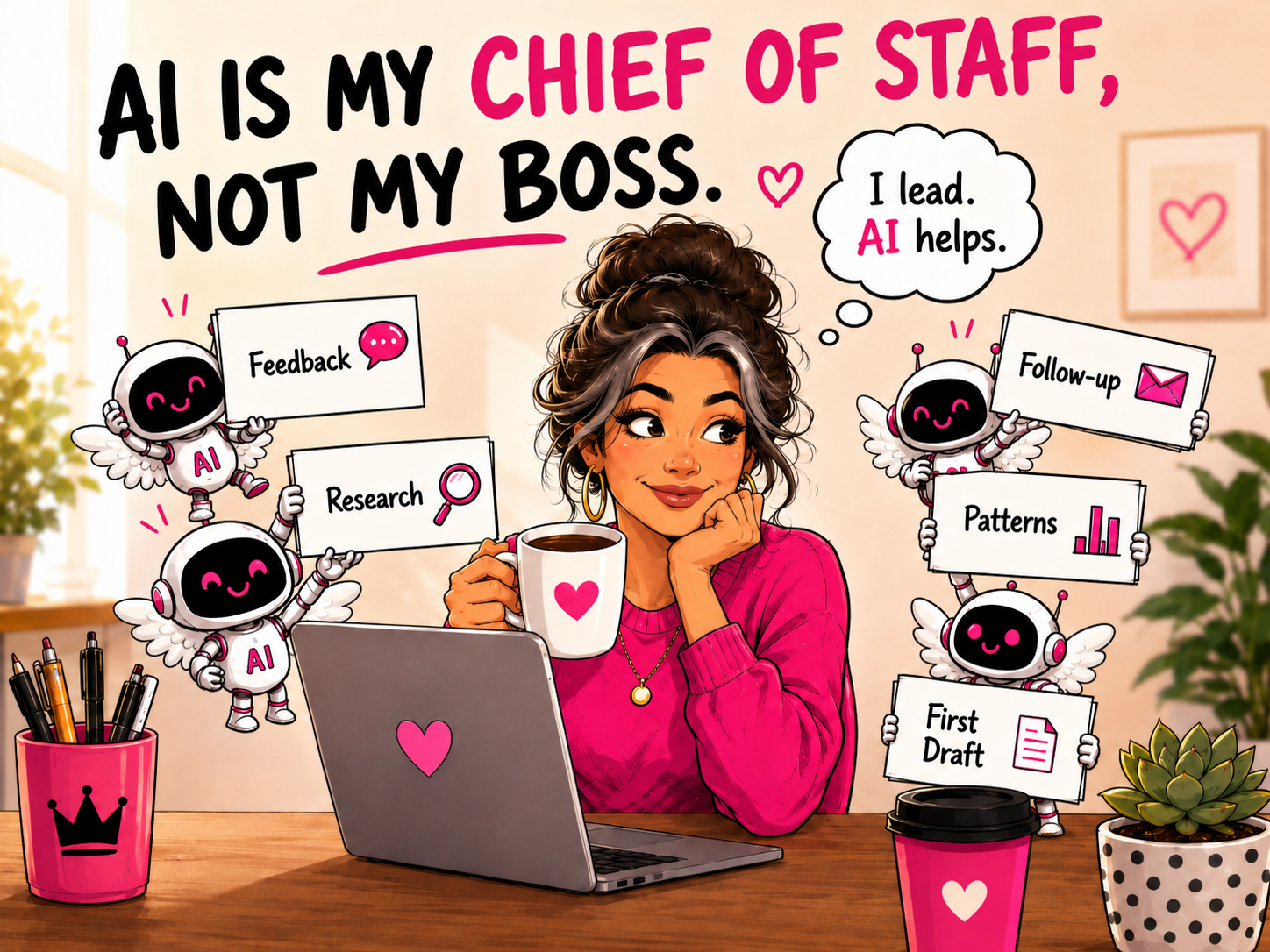
They are not asking AI to run the business. They are asking it to assist a business that already has direction.
That is the difference.
One well-trained tool connected to a clear strategy will often outperform five expensive tools used without one.
The industry may not like that message because it does not sell as many subscriptions. It is still true.
AI is not the strategy
Artificial intelligence can be extraordinarily useful. It can save time, improve communication, reduce repetitive work and help small teams operate with greater consistency.
But it is not a substitute for understanding your business.
It will not decide what you stand for. It will not tell you which customer is worth serving. It will not repair an offer nobody wants or create trust where none exists.
Those responsibilities still belong to the business owner.
This is why the question should not be, “Which AI tool should I buy next?”
The better question is, “What problem am I actually trying to solve?”
Until that question is answered, another tool is likely to become another monthly charge sitting quietly on the bank statement.
The business owners who gain the most from AI will not be the ones who chase every update, collect the most prompts or automate the highest number of tasks. They will be the ones who do the difficult, unglamorous work first.
They will think clearly.
They will understand their customers.
They will simplify their offers.
They will build systems that make sense.
Then they will use AI to make those systems faster, stronger and more consistent.
The tool comes after the thinking.
It always should.
Before you buy another AI tool
The next time someone tells you that a new platform will transform your business, pause before entering your card details.
Ask whether you have clearly named the problem the tool is meant to solve. Ask whether the process already works manually. Ask whether the tool fits into your current system or simply creates another place for information to disappear.
Most importantly, ask whether you are buying technology because it is genuinely useful or because making another purchase feels easier than making a decision.
You may not need a better AI tool.
You may need better questions.
That is the work I do inside AI Blueprint. We get clear on your client, your offer, your message and your voice before building an AI system around your business.
Because your business does not need more random AI.
It needs AI that knows where it is going.