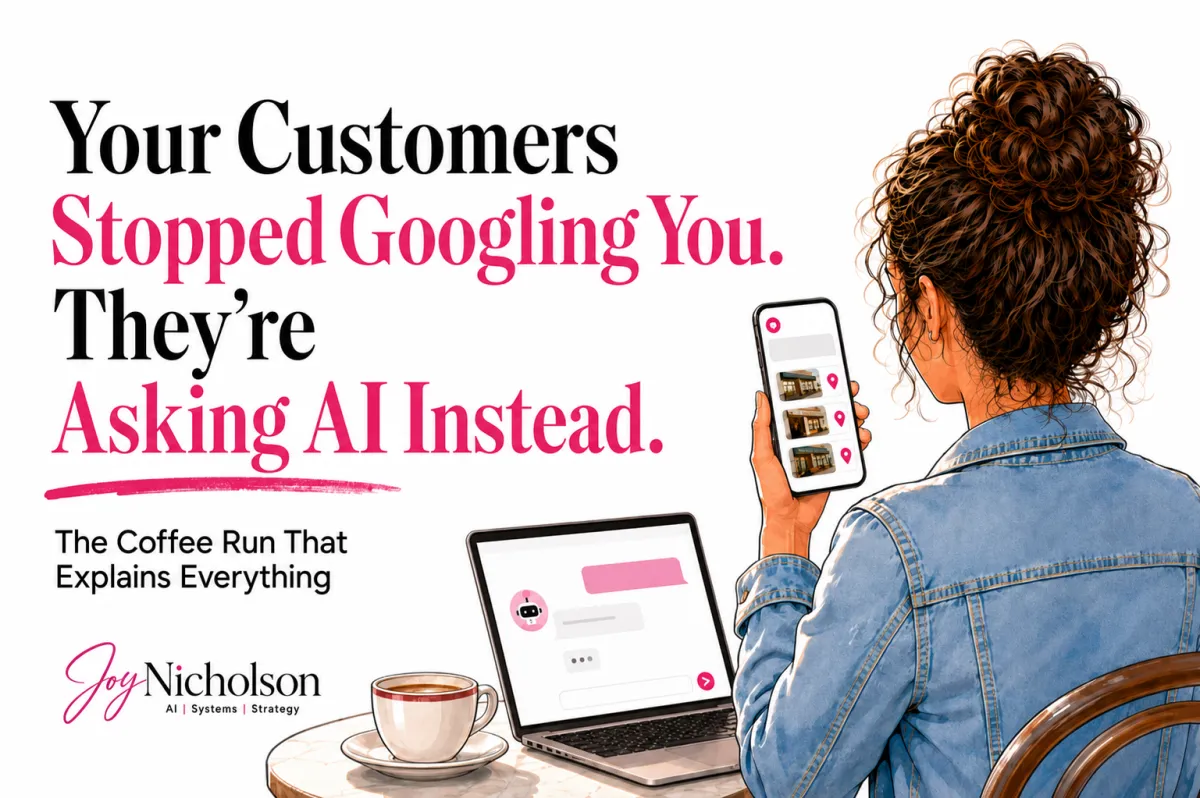
Your Customers Stopped Googling You. They're Asking AI Instead.
The Coffee Run That Explains Everything
Listen to this blog post:

About a month ago I had a coffee catch up with a LinkedIn connection. We're both on the Sunshine Coast in Australia, just in different spots. Instead of opening Google Maps and trying to work out the halfway point between us, I opened Perplexity and asked it to give me three cafe options roughly at the mid point, one that actually worked for both of us.
It came back with three cafes in seconds. I shared the options with my connection, giving him the choice he chose one. I did not question the options. He did not question the options. We just picked one and went. No comparing, no second guessing, no ten open tabs and mapping Google Maps for 10 minutes.
But it got me wondering. How did it actually land on those three, and not three others a few streets over? So I dived in and asked it directly why it specifically those cafes. What I found out is genuinely useful, not just for me, but for pretty much any cafe, shop, or small business with a real address. I'll come back to that.
You've probably done a version of this yourself. You typed a question into ChatGPT last week without thinking twice about it, or Google handed you a neat little answer before you'd scrolled past a single blue link. Either way, you got what you needed and moved on. You didn't compare five websites. You barely noticed you'd stopped searching the old way months ago.
Your customers are doing exactly the same thing to you.
Google now shows a generated answer at the top to half of all searches, and that number keeps climbing every month. When that answer shows up, the businesses that used to get the click don't automatically get it anymore. Independent research this year has tracked click through on those pages falling by somewhere around sixty percent. People read the answer, get what they came for, and never scroll down far enough to see who wrote it.
That can feel like watching the ground shift under a business you've spent years building. I get it. But underneath the panic, it's the same conversation I have with almost every client who walks in convinced they need another tool.
This isn't really a new problem. It's a clarity problem, wearing a coat of different colours.
An AI cannot recommend a business it does not understand.
Being clear about who you are is now the whole game
Every AI tool deciding whether to mention your business is quietly comparing notes. Your website, your Google profile, your LinkedIn, the About page you wrote three years ago and never looked at again. If those all say roughly the same thing about who you are, what you do, and who you help, the AI reads that as trustworthy. If they contradict each other, or if half of them are vague enough to describe a hundred other businesses, the AI moves on to someone easier to trust.
This is the same clarity work I talk about with clients. It's just showing up in a new place now.
Say the useful thing first
AI tools aren't reading your website the way a person does. They're scanning for the part that actually answers the question, and they'll use whichever page gets there fastest. A page that spends three paragraphs setting the scene before it says anything useful gets skipped for the competitor who just answered the question in the first sentence.
That's uncomfortable if you were taught to warm the reader up before making your point. It's still worth practising. Say the true, useful thing early. Tell the story after, not before.

What other people say about you matters more than what you say about yourself
AI systems weigh outside mentions, genuine reviews, and other people talking about your work more heavily than your own marketing copy, because your own copy is easy to write and hard to verify. A genuine review, a mention on someone else's site, a client naming you by name somewhere public, all of it carries more weight than another paragraph on your homepage telling people you're the best in your field.
That's not a reason to go chasing fake reviews. It's a reason to actually ask the happy clients you already have to say something, publicly, in their own words.
If you have a shopfront, this matters even more
Remember that question I asked Perplexity, about what would make it leave a good cafe off the list? The answer was more specific than I expected, and it applies to every small business with a real address, not just cafes.
A cafe sitting on a 4.8 star rating with twelve old reviews will often lose to one on 4.6 with three hundred recent ones. Volume and recency beat a slightly higher number that isn't moving. If a business's name, address, or phone number is written differently across Google, its own website, and its social pages, the AI can start treating it as an unreliable listing rather than trusting it's even the same business. And if the hours or the suburb aren't clearly and consistently stated, it gets left off the shortlist entirely, not because it was worse, but because it was harder to verify.
None of this is really about coffee. If you run a clothing shop, a clinic, or anything with a physical door people walk through, this is the part you cannot skip. Keep your Google profile current. Keep asking real customers to leave a review. Make sure your hours, address, and name say the exact same thing everywhere someone might find you.
That's not glamorous work. It's the work that gets you picked. By the way, have a chat with me about setting it up.

Go and check, right now
Here's the fastest way to see where you actually stand. Open ChatGPT or Perplexity and ask it the exact question your ideal client would ask. See what it says about your industry, and whether your name comes up at all.
Most business owners have never done this, not once. It takes five minutes and tells you more than any audit, because you're looking at exactly what your future client sees.
You don't need a new set of rules
None of this means learning a whole new skill set or hiring someone to chase an algorithm that will change again in six months. It means the same thing I always come back to.
Get clear about who you help and what you actually do. Say it the same way everywhere. Let the AI catch up to a business that already knows itself.
The businesses winning this aren't the ones with the biggest budget. They're the ones who did the clarity work first.
Have you actually asked an AI what it thinks your business does? Try it this week and see what comes back.
This is exactly the kind of thing we work through in an AI Blueprint session. Ninety minutes, just us, going through what AI is actually saying about your business right now and what to do about it. I keep these spots limited, so message me on WhatsApp if you'd rather have a chat first before booking.
Joy Nicholson is an AI brand voice consultant and AI educator based on the Sunshine Coast, Australia. She helps small business owners locally and globally build simple AI systems so they can communicate better with clients and run their business without losing their voice. She also founded the Curious Kea Brand For Kids. Find her at https://www.joynicholson.com/


